
Scott County Warrant Searches
Scott County publishes no single all-warrant search. The right route depends on the case. Traffic tickets, misdemeanors, ordinance violations, citations, payment plans, and failure-to-appear questions belong first to the Waldron Department of Scott County District Court. Felony matters in circuit court start with Arkansas CourtConnect as an initial lead, then move to the Scott County Circuit Clerk for follow-up. The Scott County Sheriff is the local contact for service and custody questions, though its page offers no public warrant-search form. Before calling, gather details. Bring the full legal name, the court, and any case, citation, or payment-plan number. A name alone matches too many people. Skip sending a birth date or license number over an insecure channel. An active warrant changes the math. An attorney can contact the clerk, read the response, and plan the next step without treating any online result as final on a Scott County warrant.
- Identify whether the matter belongs in District Court or Circuit Court.
- Search CourtConnect for public case information, or use the state citation or payment-plan tool for a district matter.
- Call the correct clerk with the case, citation, plan, or court-date details and ask for current public status.
- Contact the Scott County Sheriff when the question concerns service, custody, or which court issued the warrant.
- Use a focused Arkansas FOIA request for a releasable record, then consult counsel before surrender or bond decisions.
Scott County Has No Master Portal
The biggest limit in Scott County is that no official public roster of all outstanding warrants exists. That says nothing about how many warrants are open. It only means residents work through the issuing court. The sheriff's page offers a general phone contact, while the court systems keep case, citation, and payment-plan details in separate places.
Direct answer: A blank web search cannot prove that no Scott County warrant exists. Confirm present status with the issuing clerk.
The official Arkansas district-court directory identifies the Scott County court and clerk contact.
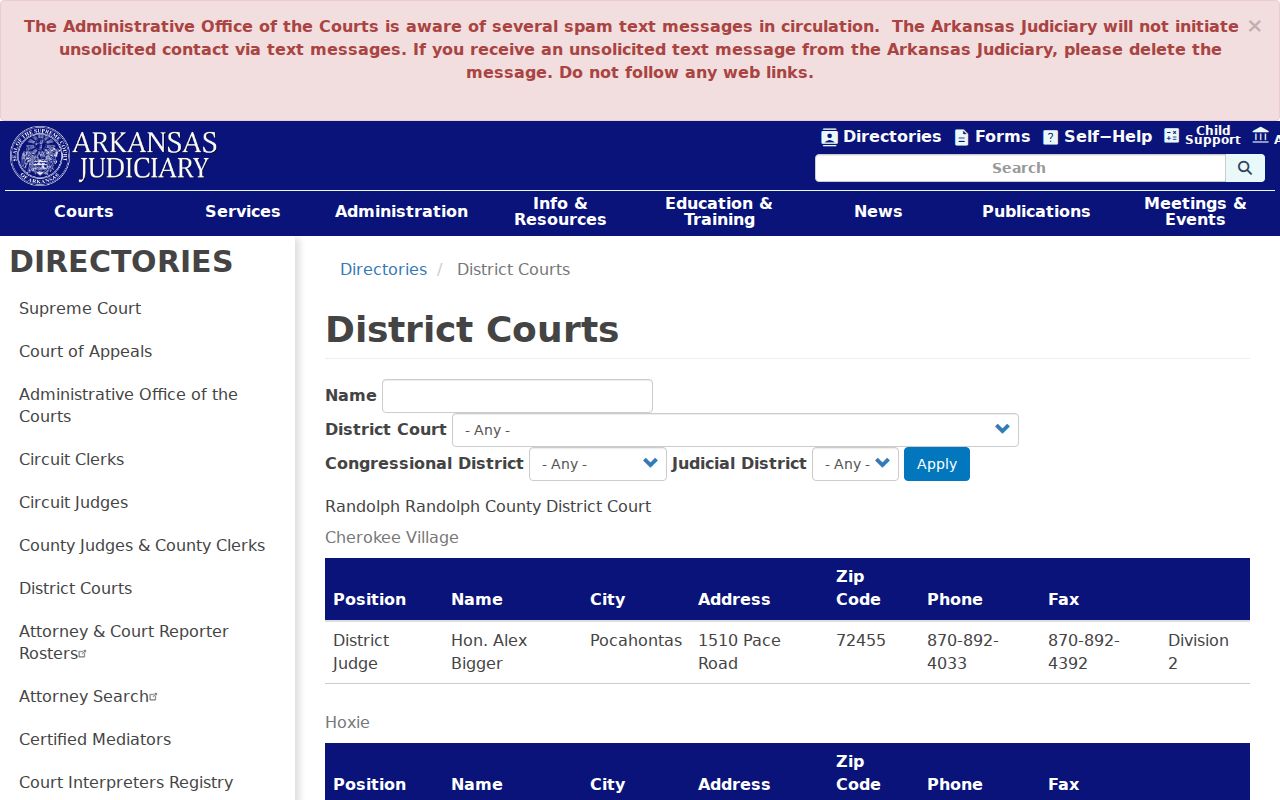
The directory points to the local courts rather than to a live warrant roster. That split guards against a common mistake. A docket may show no warrant field, or no docket may appear because a record is restricted. Neither outcome is a status certificate.
What a Warrant Search Asks For
Scott County offers no local warrant search form. The nearest official inputs sit in Arkansas CourtConnect and the state payment portals. CourtConnect takes a participant or case-number path, with advanced filters to narrow a public case lead. The citation tool accepts a court-and-name route or a citation number. Its alternate path uses a driver's-license number and date of birth on the secure state page. The payment-plan tool works with a court and name, a plan number, or that same license-and-birth-date route.
| Field Label | Type | Required | Notes |
|---|---|---|---|
| Participant name | Text | Route dependent | Use as a lead; common names need more checks. |
| Case number | Text | No | Best CourtConnect key when already known. |
| Court | Selection | Yes on court route | Select Scott County District Court for local citation or plan searches. |
| Citation or plan number | Text | Yes on that route | Searches the matching payment record, not all warrants. |
| License and birth date | Secure fields | Yes on alternate route | Enter only on the official Arkansas portal. |
Scott County CourtConnect Limits
Arkansas CourtConnect finds public case information by participant or case number. Advanced search narrows results with court and case details. For Scott County Circuit Court matters, a docket found there can show which office deserves the follow-up call. It is a case-search tool, not a live warrant registry. Administrative Order 19 keeps some court information offline. A missing result may reflect a spelling slip, the wrong court, a delay, or a record that is not public. A visible case can also change after its last entry. Ask the Circuit Clerk to confirm the docket. The clerk can give the proper court contact for Scott County too. CourtConnect alone neither confirms an active warrant nor clears a person.
Scott County Warrant Search Results
A search returns layers of records, not one warrant card. CourtConnect may list case identity, public party details, the court, filing events, charges, and docket entries. Citation and payment-plan portals show payment records tied to their narrow purpose. A clerk can confirm a warrant order, its return, or later court action when that detail is public. In Scott County, read the court and case number first, then the newest entry.
| Record number | A case, citation, or plan key such as SCOTT-CASE-NUMBER; no local public warrant-number format was verified. |
|---|---|
| Charge or event | The source wording and date, which must not be turned into a finding of guilt. |
| Issuing court | The District Court or Circuit Court division that owns the matter. |
| Bond information | Only a court or authorized officer can confirm current terms; no local schedule was verified. |
| Status event | Issued, served, recalled, or resolved language when a releasable source actually shows it. |
Scott County Citation Searches
The Arkansas online citation payment portal covers Scott County District Court traffic and citation matters. Pick the court and enter the name fields. A secure citation-number path is also offered, along with a license-and-birth-date option. This is not a broad Scott County warrant check. Its worth lies in locating the citation record and the court behind it. Payment carries legal weight. Read the official notice about plea or waiver terms and failure-to-appear consequences before sending any money. A blank result does not prove no warrant exists. Call Chief Clerk DesiRae Hall at the Waldron Department at (479) 637-4694. Ask whether the record is online, whether an appearance is required, and what status the court can confirm, because paying a ticket alone may not recall an FTA warrant.
Scott County Warrants: Who Holds What
For a Scott County warrant check, two offices split the work. The lower court side sits with Scott County District Court, Waldron Department, which handles traffic, misdemeanor, ordinance, first-appearance, bond, and warrant matters under the 24th Judicial District plan. Cases from the Mansfield and Waldron police departments file through that department. The city itself posts no warrant portal of its own, so that court and its clerk are the practical starting point for a municipal warrant question. Felonies run through a different door. The Circuit Court of the Fifteenth Judicial Circuit, Division 1, handles felony criminal cases, and the Scott County Circuit Clerk keeps and routes the circuit criminal case record for that court. Call the clerk at (479) 637-2642 or visit 190 W 1st St, Box 10, Waldron, AR 72958; the Sheriff can be reached at (479) 637-4156 for service or custody routing. There is no public statewide active-warrant registry to lean on instead. ACIC and NCIC wanted-person files stay restricted to law enforcement, and ARCH expressly leaves out active warrants and traffic history.
Scott County No-Result Checks
The Judiciary's Scott County judicial assignment page gives an official look at how the district's courts are staffed.
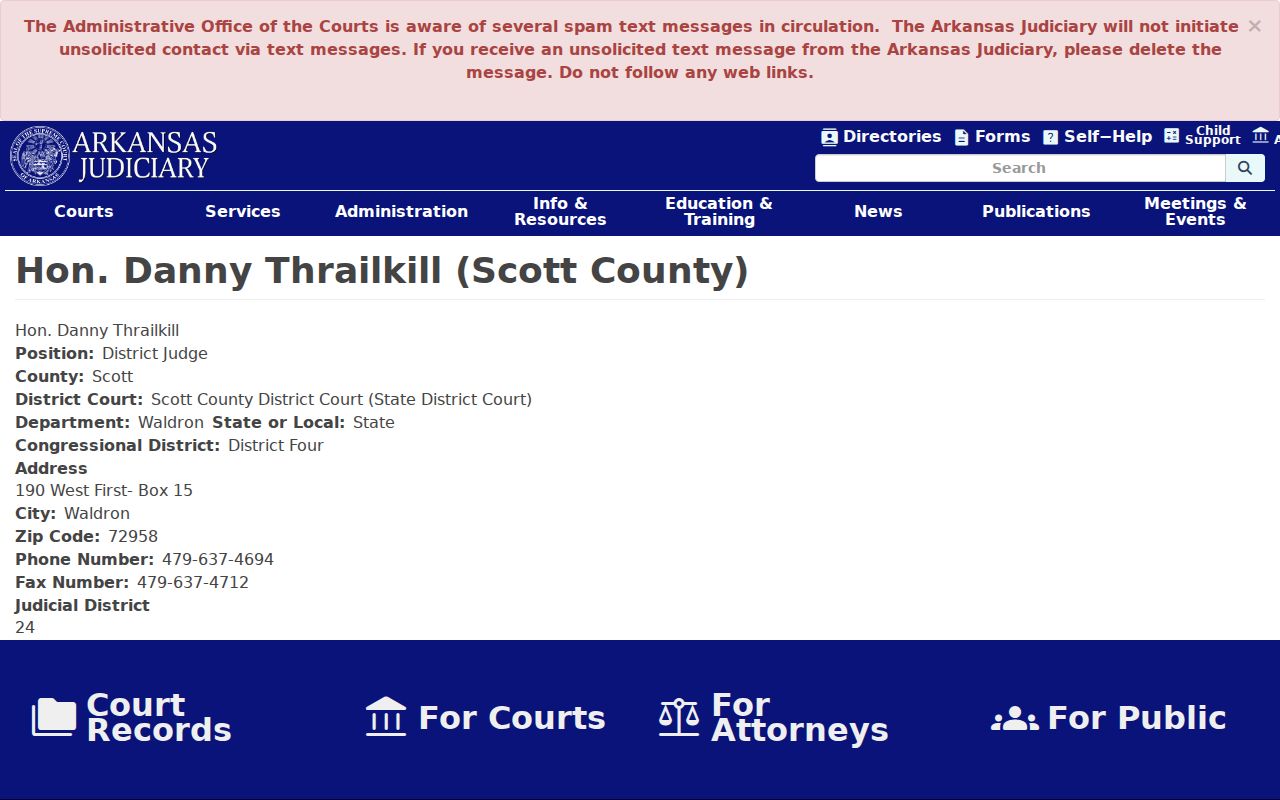
That assignment helps you pick the right court before reading any result. A blank screen needs diagnosis, not a verdict. Check spelling and name order first. Try a case number if you have one. Make sure the court level matches the event, since traffic and misdemeanor matters route to the Waldron Department while felony circuit cases go through the Circuit Clerk. A city label is no shortcut either, because Mansfield and Waldron police cases all land in Scott County district court.
- Ask whether the record uses a different name form.
- Ask whether it is too new for online display.
- Ask whether online access is limited.
- Ask whether another court is the custodian.
- Ask what identifier is safe to provide.
Then confirm current public status directly. Court records can change after a Scott County search, and a served or recalled warrant may no longer look active.
Scott County FOIA Record Route
When a releasable court or sheriff record is not online, a focused Arkansas FOIA request can get it. Direct it to the likeliest office. Name one record type, the court, a date range, and a case or citation number if you have one. Say whether you want inspection or an electronic copy. Ask for a fee estimate up front. Request the legal basis for anything withheld. Custodians may route the request elsewhere, redact protected fields, or deny access under a court rule or statute. Ask for nonexempt portions anyway. Never assume the whole file must be open. The Arkansas Attorney General's FOIA materials spell out the public-record baseline and the exemptions. A records request is no substitute for a current-status call, because a warrant can change after the responsive record was made. Scott County publishes no warrant-specific FOIA form. It names no warrant custodian either. The Circuit Clerk is the practical route for circuit criminal records, the District Court clerk for district matters, and the Sheriff for law-enforcement records it actually keeps. Keep the Scott County request narrow, neutral, and free of private data nobody needs.
Which Warrants Stay Restricted
The Arkansas Freedom of Information Act of 1967, Ark. Code § 25-19-101 et seq., backs public access to records held by public employees, but it does not erase court rules or confidentiality laws. Some records stay closed. Juvenile, sealed, expunged, protected, investigative, security-sensitive, and operational law-enforcement material may be restricted or redacted in Scott County. CourtConnect also omits some information under Administrative Order 19.
Key Rules:
Sealed and protected records are not routine public search results. Arkansas juvenile records receive special confidentiality treatment. A warrant or field may be withheld while law-enforcement or court restrictions apply.
A focused FOIA request should name the office, record type, date range, case or citation number, and desired format. Ask for a redacted or nonexempt portion if content is withheld. Never republish private identifiers.